Arts Education Creating Student Success in School Work and Life March 2017
Combining science and the arts is a way to spur student innovation, says Cleary Vaughan-Lee, Education Managing director, Global Oneness Project. She shares why information technology is important to connect the two besides as examples of projects happening across the country.
Join Cleary for #GlobalEdChat on Twitter this Thursday, January 26 at 8pm Eastern time to proceeds more than insight into STEAM and learn about additional resources and teaching strategies.
By guest blogger Cleary Vaughan-Lee
I recently visited the California Academy of Sciences in San Francisco with my son. In between visits to the living roof, the earthquake exhibit, and the planetarium, we viewed paintings by Andy Warhol. In his signature style of vivid colors, Warhol created "Endangered Species" in 1983. The ten screen prints create a drove that depicts endangered animals from effectually the world, including the blackness rhinoceros, the African elephant, and the Siberian tiger. These works of fine art fit right in at such a renowned science museum.
Our experience was a confirmation of the famous argument by American author and biochemistry professor Isaac Asimov: "There is an art to science, and a science in art; the two are not enemies, simply different aspects of the whole." Consider for a moment the unproblematic pattern of a pinecone or the symmetrical dazzler of a sunflower. Many would see these as nature'south art, but they also represent nature's science, comprised of spirals that reflect the Fibonacci sequence, which has captivated architects, mathematicians, musicians, scientists, and artists for years.
The Arts Affair
Together, art and science in educational activity accept the power to spark innovation in students. As John Maeda, president of the Rhode Island School of Design (RISD) wrote, both scientific discipline and art ask the post-obit big questions: "What is truthful? Why does it matter? How can nosotros move society forrad?" These are large, cardinal questions that impact the integration of inventiveness, imagination, pattern, and the evolution of gild. This line of inquiry can inspire and motivate students as they navigate their way through our always-changing global environs.
RISD has championed the STEAM movement and created StemtoSteam. The STEAM movement—integrating the arts into science, technology, technology, and math—has been gaining momentum over contempo years. Why practise the arts affair? Co-ordinate to Dr. Jerome Kagan, a research professor of psychology at Harvard University, "Fine art and music crave the use of both schematic and procedural knowledge and, therefore, amplify a kid's understanding of self and the world."
Imagination Enhances Science
I take recently been inspired past a number of teachers who integrate environmental science and art in their classrooms. Whether bringing together poetry with observational scientific discipline or art and music with ecology, these teachers are helping students learn while also expanding their experience of education, culture, and their ain daily lives.
Kim Preshoff, a TED Ed Innovative Educator, believes that one of the best means to achieve kids—and for kids to reach their potential—is to offering them choices. Preshoff gives students in her AP environmental science classes at Williamsville N High Schoolhouse in New York the choice to integrate art in their science projects. Some popular projects with her students include creating an ecology board game, an environmental parody of a song, and a recycled art project.
"Imagination can enhance science," says Preshoff. She believes art can encourage diverse thinking, potentially creating solutions for global problems that may non have been idea of before in the field of science. Along with heart schoolhouse history instructor Jennifer Hesseltine, she created Global Speed Chat, a worldwide collaboration platform on which students respond to prompts and post their experiences. Students tin can create a visual representation of the United Nations Sustainable Development Goals or a global verse form. Bringing fine art into the scientific discipline classroom can help break downwards learning barriers to create educatee success.
Overcoming Barriers to Science Learning
"What is it about learning scientific discipline that is then difficult or challenging that most students choose not to go along taking science beyond the required courses...?" This is a question that University of New Brunswick Professor Karen Sullenger is addressing in her research. She identifies iv potential learning barriers to learning science, including: prior experiences (descriptions students may use about the world around them versus those used in science), science language, a lack of "science-as-civilization," and preferred ways of learning, or different learning modalities and styles.
What's needed, describes former Cornell University President David J. Skorton, is a broader humanistic pedagogy that begins in K-12 instruction but continues beyond. "It is through the study of art, music, literature, history and other humanities and social sciences that we gain a greater understanding of the homo condition than biological or physical science lonely can provide." Art, with its source in creativity and ingenuity, can help move beyond these barriers, supporting creative thinking, imagination, and innovation.
Mary Ellen Newport is a proponent of this arroyo. She is a science and ecology teacher at the Interlochen Center for the Arts, a 1200-acre campus in northwest Michigan. The school offers arts education programs for students in grades 3-12 and for adults. Their mission argument describes a dedication " to the promotion of globe friendship through the universal language of the arts." Approximately 20-five percent of Newport'south students are from countries other than the United States, and many are at a pre-professional level of study in the arts, including creative writing, trip the light fantastic toe, music, motion picture arts, theater, and visual arts.
This yr, Newport started her environmental course by request students to reflect on their relationship with the natural world. One of the simple goals for the yr is for students to sympathise that everything is connected in the northwest backwoods.
During a unit on ornithology, students learned how to use binoculars, place local birds past sight and sound, and use tech tools for identification. Additionally, they employed "citizen science" to written report bird sightings. Newport explained that, for one project, students essentially "prefer" three birds, describe them, so trace their cartoon on compress art pic. When birds on film are shrunk, the colors and beefcake really come alive. Newport described that her goal for this exercise is for students to carefully observe bird anatomy in an engaging way.
Newport requires that her international students bring the ecological bug from their home countries or regions into the classroom. For example, her class learned about particulate pollution in China, the 'tar sands' of Canada, and how mangrove forests are threatened in Vietnam by conventional shrimp farming. Newport said, "As trade and communications and environmental problems have brought the world closer together, I cannot imagine teaching my form without addressing global, planetary problems."
Reaching Hearts and Minds
Another example that merges art and the environment comes from Louisiana elementary school teacher Harriet Maher. She implements the River of Words (ROW) in her classroom, a program that encourages students to explore the natural globe through local watersheds. Founded in 1995, ROW is a program at St. Mary's College in California. Co-founder Pamela Michael explains that the didactics is to teach art and science in tandem. The goal, she said, is to attain kids' hearts, which in turn effectively reaches the hearts and minds of the community.
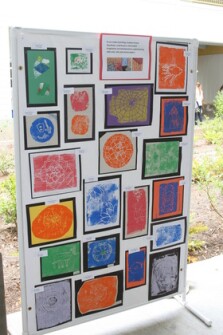
Maher told me a story of one student who had a very specific retention of walking in a field in West Texas with her grandmother. She drew the scene from retentivity and so wrote virtually the experience. The student realized that she did not have the vocabulary to describe the establish that had taken over the field, as she had not seen the establish in her habitation country of Louisiana. She spent fourth dimension examining field guides and found it—big bluestem. The proper noun constitute its way into her poem along with additional details that added authenticity.
Maher explained, "In one case the student could name it, she endemic it. We saw that kind of investigatory curiosity time and over again when students struggled to express of import truths about their experiences with the stars, animals, and, of form, bodies of water. The interesting thing, though, was that idea of writing with more than specificity became much easier for them to apply in other genres after they saw how information technology worked in poesy."
These teachers are bringing the arts into environmental science. But if art and science are unlike aspects of the whole, equally Asimov says, and so fine art has a identify in other science courses as well. With its power to engage the power of creativity and innovation and reflect the well-nigh universal experiences of the human and natural world, art might have a role to play in all of our classrooms to build successful global citizenry for the future. Newport sums it up nicely, "In the arts and sciences, interdisciplinarity and collaboration are the way artists and scientists do concern. We would do our students a grave disservice if we pretend that disciplinary silos reflect any function of the way arts and sciences proceed in the so-called 'existent globe.'"
Connect with Cleary, Global Oneness Project, Heather, and the Eye for Global Education on Twitter.
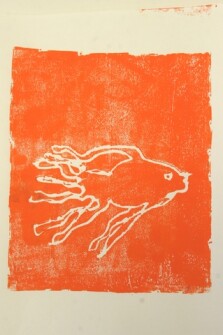
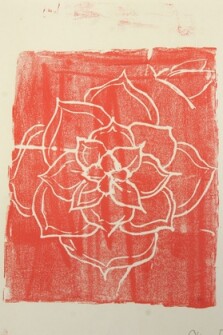
Photos courtesy of Harriet Maher and Cindy Lassalle. "Fish" is by student Emma Warren. "Magnolia" is by student Olivia Faul.
The opinions expressed in Global Learning are strictly those of the author(due south) and do not reflect the opinions or endorsement of Editorial Projects in Pedagogy, or any of its publications.
houghtontheatchere44.blogspot.com
Source: https://www.edweek.org/teaching-learning/opinion-art-and-science-working-together-for-student-success/2017/01
Post a Comment for "Arts Education Creating Student Success in School Work and Life March 2017"